
November 2026 · 9 min read
Quick answer
"Many new restaurants in India shut down within their first few years, and the reason is rarely the food. It's usually weak sales against heavy rent, food waste, poor staff management and running the outlet on gut feeling instead of data. The restaurants that make money track almost everything.
This guide shows you the real numbers, a break-even formula, a pre-opening checklist, and how an all-in-one system like ZESTO OS keeps you on top of it."
Every month, someone in Lucknow, Jaipur, Indore or Pune decides this is the year they finally open their own restaurant. They pick a location, design the interiors, hire a good cook, print the menu and plan a launch party.
What most of them don't plan for is month six. The month when rent is due, the footfall is lower than the projections, the vegetable bill is higher than expected, two staff members have quit, and the owner realises they have no clear idea where the money is going.
This post is for you if you're about to open a restaurant, or you're thinking about it. It's a straight look at why restaurants fail in India and what the survivors do differently.
There is no single official all-India dataset, so the honest answer is: it depends on who you ask, but every credible number is uncomfortable.
Hotshare, a firm that funds restaurant businesses, says 80% of restaurants close within their first five years (YourStory, October 2026).
Outlook Traveller's restaurant guide describes an industry-wide "three-year jinx", where roughly 60% of new restaurants fail or change ownership within three years (September 2026).
You'll also hear "60% fail in the first year" and even "90% fail in the first year" quoted in India. Those first-year figures are widely repeated, but they trace back to older, loosely sourced claims. Some US studies, based on government business data, put first-year closures far lower, around 17%.
So should you trust the scary numbers or the calmer ones? Neither blindly. The useful takeaway is this: even on the optimistic end, roughly half of restaurants don't make it to year five, and the failure rate is much higher than in most businesses. You are not planning for the average. You are planning not to be in the half that closes.
Ask ten restaurateurs and you'll hear the same handful of reasons.
1. Sales that never match the plan. The projection said 150 covers a day. Reality is 60. Often the demand was assumed, not tested. Nobody checked how many people actually walk past, what they spend, and what the neighbourhood already offers.
2. Rent that's too heavy for realistic sales. Rent is fixed. It doesn't care if it rained all week. A good location that costs too much can quietly drain a restaurant that looks busy.
3. Food waste and uncontrolled stock. Studies from groups like ReFED estimate restaurants waste 4 to 10% of the food they buy. When the typical profit is only 3 to 5% of sales, that bin can hold half your profit. We broke down the math in our post on [how food waste cuts into restaurant profit margins](INTERNAL LINK: /blog/food-waste-restaurant-profit-margins).
4. Poor staff management. High turnover, no proper shift planning, inconsistent portion sizes between cooks, no accountability for stock. Good staff are expensive to lose and slow to replace.
5. Running on gut feeling. This is the one that connects all the others. Restaurateurs often spend heavily on interiors and equipment but very little on systems, a point several operators made to Outlook Traveller when discussing why restaurants fail. If you can't see your numbers, you can't fix your problems.
Making it past the first couple of years doesn't mean making money. A lot of surviving restaurants sit in an uncomfortable middle: busy enough to stay open, not profitable enough to grow. Think of an owner working 14-hour days to end the month at roughly zero.
That's not surprising when you look at the margins. The typical full-service restaurant keeps only 3 to 5% of sales as net profit. On ₹10 lakh of monthly sales, that's ₹50,000. A rent hike, a wasteful kitchen, or a poorly scheduled team can erase it in one month.
This is also why the difference between a profitable restaurant and a break-even one is usually small leaks, not one big mistake.
They know their numbers. Not roughly. Exactly.
The owners who consistently make money know every small detail of their outlet. Here's what they usually track:

None of this is glamorous. But it's the difference between feeling busy and knowing you're profitable.
If you do only one thing from this article, do this. Break-even sales is the amount you must sell each month just to cover your costs.
Break-even sales = Fixed costs ÷ (1 − Variable cost ratio)
Fixed costs are things like rent, salaries, electricity and software. Variable costs are things that rise with sales, like ingredients, packaging and aggregator commissions.
Here's an illustrative example:
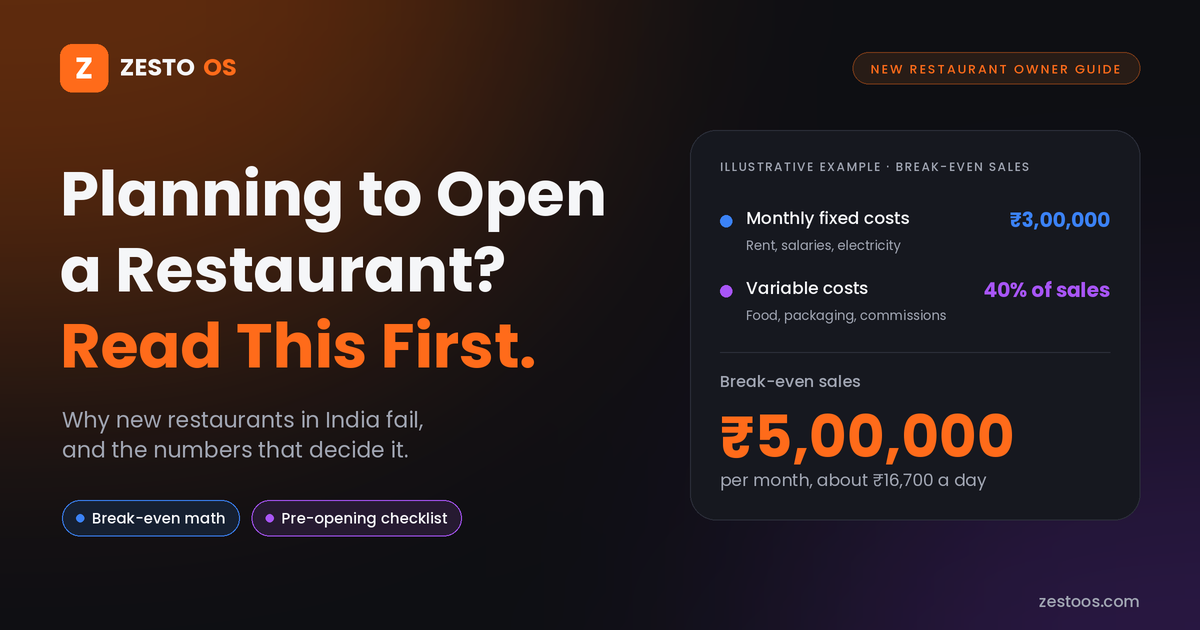
Monthly fixed costs: ₹3,00,000
Variable costs: 40% of sales (food, packaging, commissions)
Break-even sales = 3,00,000 ÷ 0.60 = ₹5,00,000 per month, or about ₹16,700 per day
Now ask the uncomfortable question: can your location realistically do ₹16,700 a day from the first few months? If you aren't sure, that's the number to test before you sign anything.
Test demand first. Spend a few days counting footfall near your location at lunch, evening and weekends. Visit competitors and note their rush hours.
Calculate break-even using the formula above, with conservative sales numbers.
Keep rent in check. If rent eats too much of your realistic sales, renegotiate or rethink the location.
Keep the menu tight. A smaller menu with shared ingredients means less stock, less waste and faster service.
Standardise recipes and portions from day one so every plate costs the same.
Set up your systems before opening day, not after problems start: billing, stock tracking, wastage logs, vendor records and staff schedules.
Plan a cash buffer for the first few months when sales are still building.
Review your numbers weekly, not yearly.
Step six is where most first-time owners cut corners, and it's the step that makes the other seven easier.
ZESTO OS is an all-in-one restaurant management platform, made in India, that runs your entire restaurant from one place. It was built for exactly this problem: owners who want to know what's happening in their outlet without juggling five apps, a register and WhatsApp messages.
With ZESTO OS you get:
POS and billing to take orders and generate bills
Smart inventory to track stock as it moves
Staff management to keep shifts and teams organised
Wastage management to log what's thrown away and see where it's coming from
Vendor management to keep supplier records and rates in one place
ZESTO AI, which analyses your restaurant's data, tells you what's going wrong, and keeps suggesting what to improve
The goal isn't more software. It's fewer blind spots. Instead of guessing why your food cost went up this month, you can see it.
It's also built to be cost friendly. ZESTO OS has a [free Starter plan with unlimited billing](INTERNAL LINK: /pricing), and the Growth plan is priced at ₹1,999 per month including GST. If you're comparing options, see how [ZESTO OS stacks up against Petpooja, Posist and UrbanPiper](INTERNAL LINK: /compare).
Most fail because sales don't match the plan while fixed costs, mainly rent and salaries, stay high. Food waste, poor staff management and a lack of data make it worse. Quality of food matters, but operations decide who survives.
There's no official all-India figure. Industry sources suggest that roughly 60% of new restaurants fail or change hands within three years, and around 80% close within five years. Treat these as directional, not exact.
Divide your monthly fixed costs by one minus your variable cost ratio. For example, ₹3,00,000 of fixed costs with 40% variable costs gives break-even sales of ₹5,00,000 per month.
At minimum you need billing (POS), inventory tracking, wastage logging, vendor records and staff management. An all-in-one platform keeps all of this connected, so your sales, stock and costs tell one story instead of five.
Look for ease of use for your staff, inventory and wastage tracking, reports you'll actually read, pricing you can afford while sales are still building, and local support. Compare a few options before committing.
It helps by showing you stock levels, usage against sales and wastage patterns, so you can order better and catch problems early. Software supports good habits, but your team still needs to follow them.
Opening a restaurant is brave. Keeping it profitable is a discipline. The owners who last are rarely the ones with the fanciest interiors. They're the ones who know their break-even number, watch their waste, manage their team well and look at their data every week.
Start with the math, set up your systems before day one, and keep your eyes on the small details. That's where the profit is.
Planning to open soon? Book a free demo of ZESTO OS
Be the first to comment on this post.
Leave a comment