
October 2026 · 7 min read
It's 11:30 on a Saturday night. Every table was full, the kitchen ran flat out, and the billing counter never went quiet. By any normal measure, it was a great night.
Then someone carries out the kitchen bin. Half a tray of cooked rice. A bucket of onion and capsicum trimmings. A gravy base made for a rush that never came. Coriander that wilted before anyone got to it.
None of it shows up as its own line on your P&L. But every bit of it was bought with real money, and in a business where the profit is only a few paise on every rupee, that bin matters more than most owners realise.
This post breaks down how food waste in restaurants eats into your profit margin, with numbers you can replace with your own, and six fixes that don't need a big budget.
Industry benchmarks put net profit for a typical full-service restaurant at around 3–5% of sales, with quick-service and fast-casual formats doing a bit better at roughly 6–9%.
Indian outlets vary a lot by city, rent and format, but the picture will feel familiar. Rent, salaries, gas, electricity, aggregator commissions and raw material all fight over the same rupee.
Of all of these, food is the biggest cost you can actually control. It usually sits at 28–35% of sales. Rent is fixed. Salaries are mostly fixed. But what happens to the food you buy, from the delivery gate to the guest's plate, is something you can change this month.
Studies from groups like ReFED, a US non-profit that tracks food waste, estimate that restaurants waste 4–10% of the food they purchase before it ever reaches a guest.
That sounds small. Most owners hear "4 to 10 percent" and shrug. The catch is that this percentage is measured against purchases, and purchases are already about a third of your sales. The real damage only shows up when you convert it into profit.
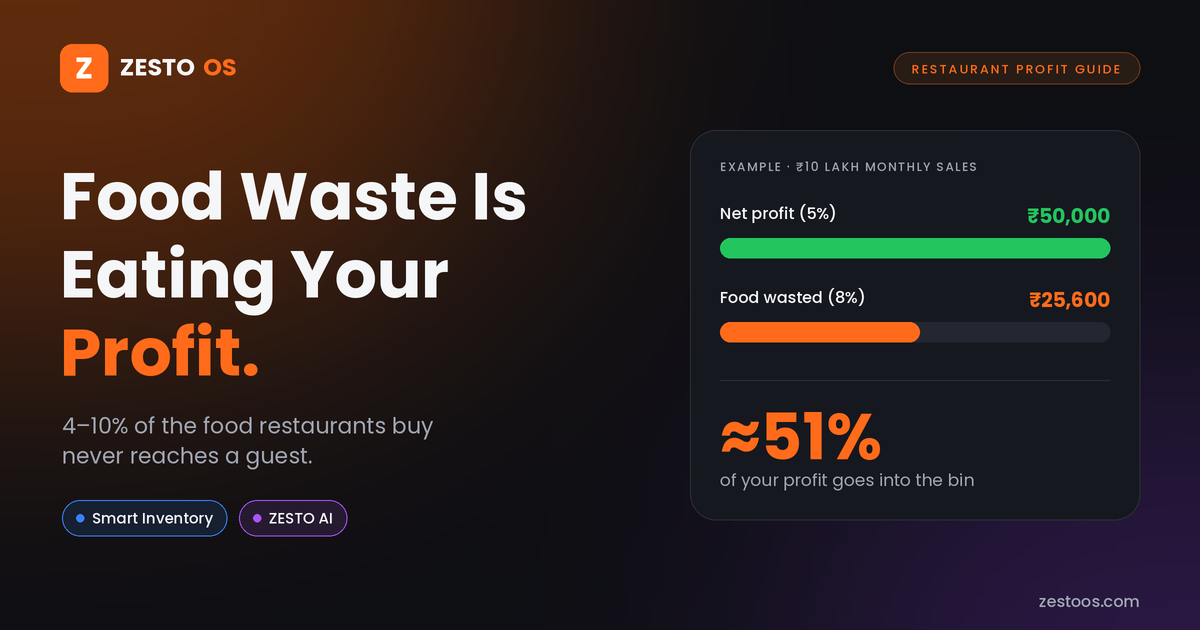
Here's a simple example. Say your restaurant does ₹10 lakh in sales a month, your food cost is 32% (₹3.2 lakh of purchases), and you keep a 5% net profit (₹50,000).

Read the 8% row again. You are binning roughly as much money as you take home. And if your outlet runs on a 3% margin, 10% waste wipes out the entire profit.
Here's the part that stings. To earn back ₹25,600 through sales alone, at a 5% margin you would need about ₹5.12 lakh in extra sales. Saving the food is far easier than selling your way out of the loss.
The table above only counts the ingredient price. The real bill is bigger.
Labour: someone was paid to peel, chop, marinate and cook food that nobody ate.
Gas and electricity: cooking and refrigerating food that ends up in the bin.
Wrong menu prices: you price dishes on recipe cost. If 8% of your ingredients never reach a plate, your real cost is higher than your costing sheet, and that "68% margin" biryani earns less than you think.
Disposal: bins, pickups, pest control and cleaning.
There's also a visibility problem. Waste is usually buried inside your overall food cost, so it never looks like a separate leak. You just see a food-cost percentage that's a bit too high and blame suppliers or rate hikes.
In most kitchens, waste happens in three places.
Before cooking. Over-ordering, poor storage, no first-in-first-out routine, and bulk buying because the mandi rate looked good that morning. Cheap per kilo is not cheap if a third of it spoils.
During prep. Heavy trimming, inconsistent cutting between cooks, and over-production of gravies, bases and marinades "just in case".
After serving. Plate waste. In the US, ReFED data suggests uneaten food on plates makes up the bulk of foodservice waste. Any restaurant with generous portions, complimentary sides or dishes that don't match what guests expected will recognise the pattern.
Put a simple log next to the bin. For every discard, write the item, rough quantity and reason: spoiled, over-prepared, returned, or plate waste. Rough weights are fine.
Almost every owner finds that two or three items cause most of the loss. You can't fix what you can't see, so start here.
Look at the last four same weekdays before placing an order, because a Tuesday is not a Saturday. Set a par level for each item, meaning the quantity you actually need on hand, and order only up to that. Bulk buy only when you can use it within its shelf life.
Prep for the first half of service, then top up. Some things freeze well, like gravy bases. Cut vegetables and cooked rice don't. Treat them differently.
Date every container. New stock goes behind old stock. Keep raw items below and cooked items above in the fridge. It takes five minutes a day and prevents a surprising amount of spoilage.
A 150-item menu means 150 ingredient headaches. Look at the dishes that rarely sell but need their own special ingredient, and ask whether they earn their place. Designing dishes that share ingredients means stock moves faster and spoils less.
Use standard scoops or katoris so every cook serves the same quantity. Offer half portions for dishes that regularly come back unfinished. Day-end surplus can become a staff meal or a next-day special where food safety allows, but never reuse food that has already been served to a guest.
The restaurants that win at this don't run one big waste drive. They spend 15 minutes every week looking at the top five wasted items, asking why, and changing one thing.
It gets much easier when stock, purchases and sales live in one system. You can compare what you should have used with what you actually used, and spot leaks without digging through registers and notebooks. If you're still running on separate billing, stock sheets and WhatsApp orders, that gap is where a lot of waste hides. "see how ZESTO OS compares with other restaurant software"
Industry estimates put it at 4–10% of the food a restaurant purchases, before it reaches the customer. Well-run kitchens sit at the low end, and kitchens with no tracking often sit near the top.
It depends on your food cost and margin, but with food at roughly 32% of sales, 4–10% waste costs about 1.3 to 3.2 percentage points of sales. When average net profit is only 3–5%, that can be a third to well over half of your profit.
Yes, and that's the problem. Waste is buried inside your cost of goods sold, so unless you track it separately, it just looks like a high food-cost percentage.
Measure it for two weeks, then fix the top two or three items causing most of the loss. Ordering based on actual sales patterns usually gives the quickest win.
It can. When billing, inventory and purchasing are connected, you can see usage against sales, set reorder levels and catch over-ordering early, instead of finding out when the bin is full.
You probably can't change your rent or your staff costs this month. You can change what ends up in the bin.
When restaurant profit margins are only 3–5%, every rupee of food you save drops almost straight to profit, while every rupee you earn in new sales only keeps a few paise. Start with a two-week waste log, fix the biggest leaks, and review weekly. Most owners are surprised by how much comes back.
Want to see your stock, sales and purchases in one place? Book a free demo of ZESTO OS
Be the first to comment on this post.
Leave a comment